Back
Back
Board Game Side Effects
This is a confrontational card game featuring elements of racing, bluffing, and hand management.
Your psyche is the battlefield, and pills are your only weapon.
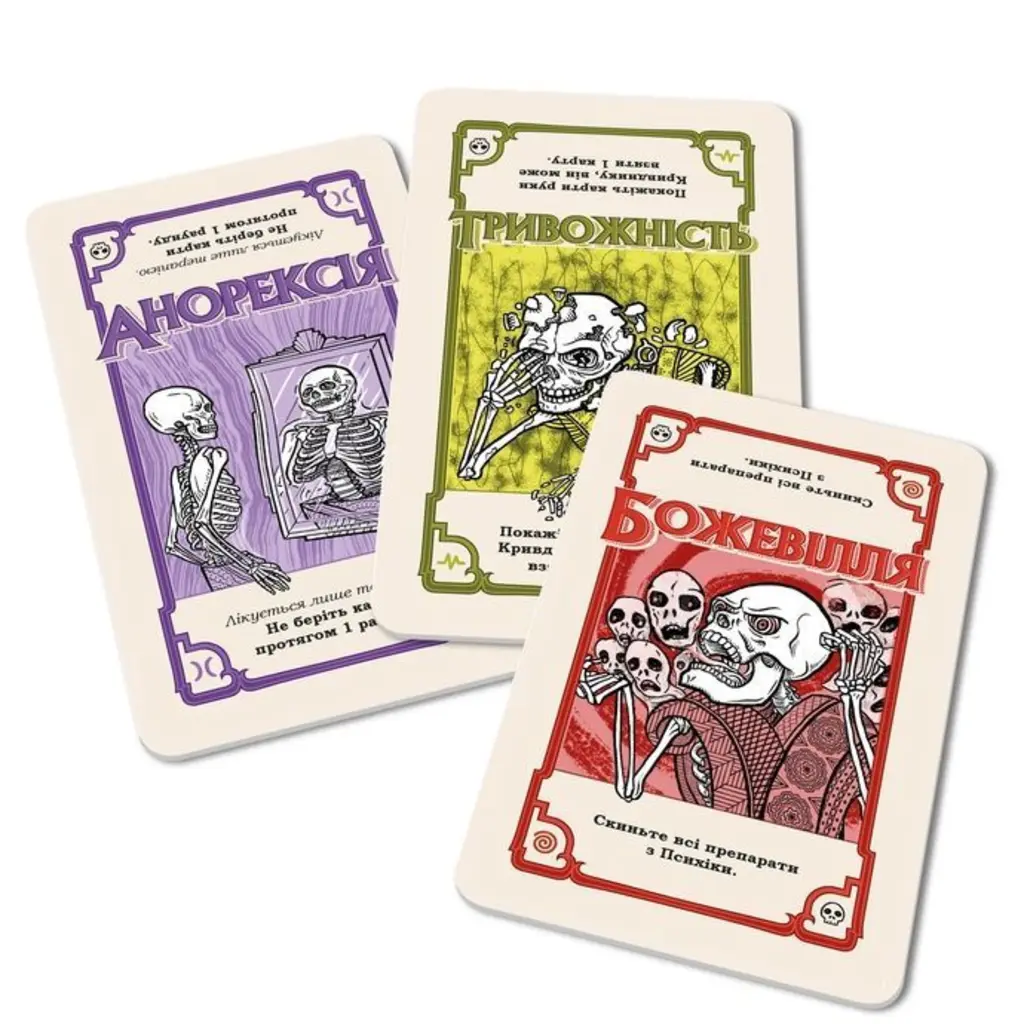
Picture a gloomy psychiatrist`s office with a medical chart lying on the desk—yours. But instead of a doctor, you face rivals waiting for the perfect moment to foist a new disorder upon you. Welcome to the world of Side Effects—a board game where the human mind becomes an arena and every pill comes at a price. There is no world to save here; the goal is simple: cure your own Disorders before anyone else does. But be careful—every Medication carries side effects that leave you vulnerable to new ailments, and your rivals will certainly take advantage of that.
How it works: from diagnosis to victory
The game begins with a setup that sets the tone: each player receives 4 Disorder cards placed face-up—this represents their Psyche, their personal set of problems. Players also draw 4 cards into their hand. From there, the process is simple, though far from easy:
- Start your turn by drawing 2 cards from the deck.
- You may play up to 2 cards per turn—though you don`t have to. Sometimes, the best strategy is to conserve your resources.
- At the end of your turn, you cannot hold more than 6 cards; any excess must be discarded.
Play proceeds clockwise. The first person to move is the one who most recently had a nightmare—and this isn`t a joke; it`s an official rule.
Four ways to play cards—and no easy path
This is where the real game begins. Each card has a specific purpose:
- Cure a Disorder in your Psyche. If you have a Medication card that treats one of your Disorders, place it on top of that Disorder card. But remember: you are now vulnerable to that Medication`s side effects—meaning opponents can inflict the new Disorders listed on that card upon you.
- Inflict a Disorder on another player. If someone has an active Medication card in play, they become vulnerable. If you hold a Disorder card to which that player is vulnerable, add it to their Psyche. There is a catch, however: a Psyche cannot contain two identical Disorders. Even if a player is vulnerable, once they have received a specific Disorder, they cannot contract it again.
- Use a Therapy card. This is a "wildcard"—a universal remedy. Discard any Disorder from your Psyche along with the Therapy card. The only exception is Tremor, which Therapy does not affect. Also, Anorexia can only be cured with Therapy—there is no Medication card for it. The downside is that a Disorder cured in this way can theoretically return.
- Trigger an Episode. Use this card to activate one of the penalties listed on another player`s untreated Disorders. They must carry it out. And you get to laugh at their suffering. It’s not just a mechanic—it’s a social experience.
Victory, defeat, and the art of negotiation
The goal of the game is to be the first to cure all the Disorders in your Psyche. But the game doesn`t end with the first winner; play can continue until only one player remains. This allows those who have lost to keep fighting for second place—or simply for the chance to make life miserable for the others.
And this is where diplomacy comes into play. You can negotiate with other players:
- You cannot play more than 2 cards per turn.
- You cannot play cards when it is not your turn.
- You can give or receive cards out of turn—but only if they remain in hand and are not played.
And if the official rules seem too strict, the game includes a "House Rules" section. Want two identical Disorders? Want to use a Medication from your own hand to treat an opponent`s Disorder? Officially, that’s not allowed. But your house, your rules.
Diagnosis: victory. Prescription: your cool-headedness.
This game balances on the edge of dark humor and serious subject matter. All the Medications and Disorders featured in it are entirely real. This isn`t done to scare you, but to add depth and encourage open conversation about mental health. The game supports efforts to improve access to mental health resources and even provides helpful links.
It’s a game for those who love:
- strategy with elements of bluffing and underhanded tactics;
- social interaction — you can negotiate, deceive, and exact revenge;
- dark humor — the themes are serious, but the presentation lets you laugh through the tears;
- replayability — every match features new combinations of Disorders and Medications.
Find out if you can heal your Psyche before your opponents do the same to you. Be the first to conquer your demons. Or, at the very least, have a laugh at someone else`s.
Publisher: WoodCat
Language: Ukrainian
Players: 2-8
Play time: 10-30 m
Age: 13+
Package dimension: 15.7 х 13.5 х 5.1 cm
- 89 cards
- game rules